ADA Title II vs Title III: Key Differences for Website Owners (2026)
ADA Title II has a hard deadline: government websites must meet WCAG 2.1 AA by April 26, 2027 (April 26, 2028 for smaller entities), after the DOJ extended the original 2026 dates. Title III has no equivalent rule yet — but it drives thousands of private website lawsuits every year. Here is what each title requires, how courts interpret them, and what website owners need to do.
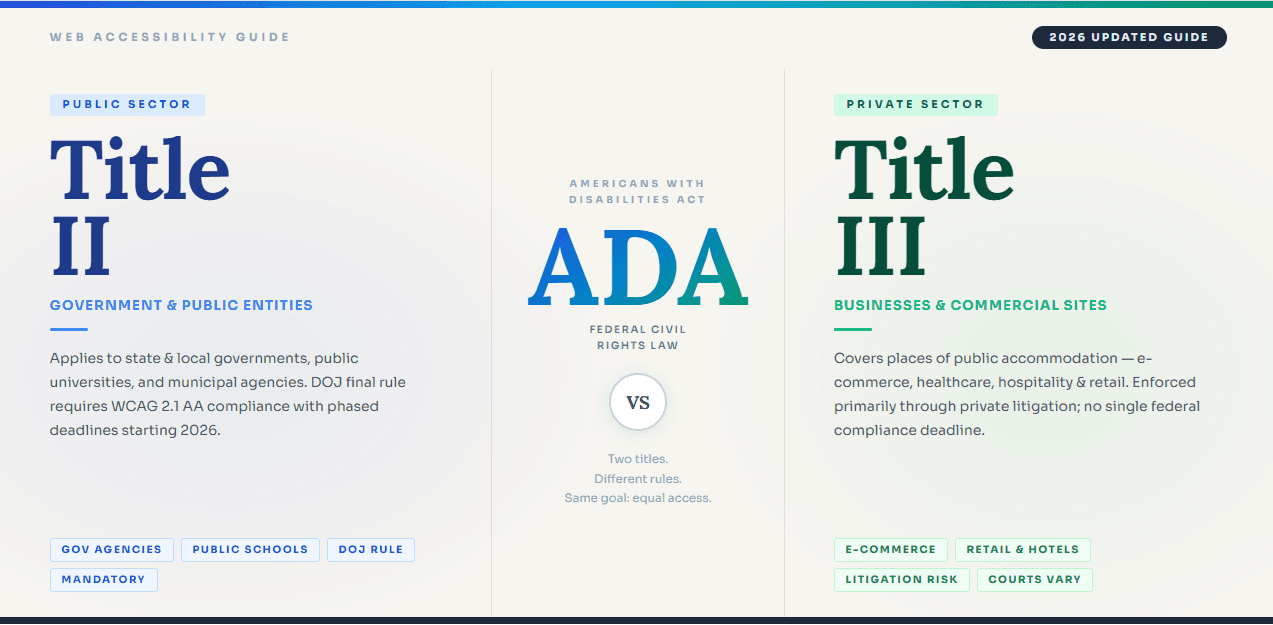
Most coverage of ADA Titles II and III focuses on ramps, restrooms, and physical barriers. That matters — but if you manage a website, the more urgent question is digital: which title applies to your site, what does it require, and what happens if you do not comply?
The answer depends on who you are. State and local government entities fall under Title II, which now has a federally mandated WCAG 2.1 AA deadline. Private businesses fall under Title III, which has no federal web rule yet — but courts have consistently ruled that inaccessible websites violate Title III, and over 5,000 website accessibility lawsuits were filed in 2025 alone.
This guide explains both titles — their requirements, enforcement mechanisms, landmark cases, and practical compliance steps for websites.
The ADA at a Glance
The Americans with Disabilities Act (1990) is divided into five titles. Two are directly relevant to website owners:
Section 508 is a separate law — not part of the ADA — that applies specifically to federal agencies and their contractors. If you sell software or services to the federal government, Section 508 may also apply to you. See our Section 508 compliance guide for a full breakdown.
Title II vs Title III: Side-by-Side Comparison
| Feature | Title II — Public Entities | Title III — Private Businesses |
|---|---|---|
| Applies to | State and local government entities | Private businesses open to the public |
| Examples | City websites, public schools, courts, transit agencies | E-commerce, restaurants, hotels, SaaS, healthcare portals |
| Website rule | DOJ Final Rule: WCAG 2.1 AA by April 2027–2028 (extended) | No federal rule yet — courts use WCAG 2.1 AA as benchmark |
| Barrier removal standard | Full accessibility required — no cost defense | "Readily achievable" — scaled to financial feasibility |
| New construction/renovation | Must meet ADA Standards for Accessible Design | Must meet ADA Standards for Accessible Design |
| Enforcement | DOJ investigates complaints; private lawsuits permitted | Private lawsuits; DOJ may also enforce |
| Damages | Injunctive relief + attorney fees (no monetary damages) | Injunctive relief + attorney fees + potential compensatory damages in some states |
| Reasonable modifications | Required — unless it fundamentally alters the program | Required for policies — e.g., allowing service animals |
ADA Title II: Public Entities
Title II prohibits discrimination by state and local governments. It covers every government entity — schools, courts, transit agencies, parks, libraries — regardless of size or federal funding status.
The Title II Website Deadline
In April 2024, the DOJ published a Final Rule under Title II specifying that government websites and mobile apps must conform to WCAG 2.1 Level AA. A follow-up rule in April 2026 extended the original deadlines by about a year. Compliance dates depend on population size:
| Entity size | Population served | Compliance deadline |
|---|---|---|
| Large | 50,000+ | April 26, 2027 |
| Small | Under 50,000 | April 26, 2028 |
This is the first time the DOJ has issued a specific technical standard for government web accessibility. Before this rule, government entities were required to make websites accessible under Title II but had no defined measure. For a complete breakdown of the rule and what it covers, see our guide to the ADA Title II deadline.
Core Title II Requirements
ADA Title III: Private Businesses
Title III requires private businesses that are "places of public accommodation" to be accessible. The ADA lists 12 categories of covered entities: restaurants, hotels, retail stores, theaters, healthcare providers, gyms, private schools, and more. If your business serves the public, Title III almost certainly applies to you.
Title III and Website Accessibility
The ADA was written in 1990 — before the web existed. The statute does not mention websites. But federal courts across multiple circuits have ruled that websites operated by places of public accommodation are covered by Title III. The logic: if a blind customer cannot use your website, they are denied equal access to your goods and services.
No federal web rule — but courts fill the gap
There is currently no DOJ final rule specifying a WCAG version for private businesses under Title III. The DOJ issued an Advance Notice of Proposed Rulemaking in 2010 but never finalized it. In the absence of a rule, plaintiffs point to WCAG 2.1 AA as the standard — and courts have accepted it. Making your site WCAG 2.1 AA compliant is the most defensible position available.
Core Title III Requirements
For a checklist of what Title III compliance looks like for a small business website, see our ADA compliance checklist for small businesses.
Landmark Cases
Court decisions have shaped how both titles apply in practice — especially for websites.
Robles v. Domino's Pizza (9th Cir. 2019)
Title IIIPlaintiff Guillermo Robles, who is blind, sued Domino's after its website and app were incompatible with his screen reader. The Ninth Circuit reversed a lower court dismissal and held that Title III applies to websites and apps that connect to physical places of public accommodation.
Established that websites serving customers of a physical business fall under Title III. Domino's ultimately settled. This case is widely cited in ADA website litigation.
Gil v. Winn-Dixie (11th Cir. 2021)
Title IIIA visually impaired plaintiff sued Winn-Dixie after its website — used for coupons, pharmacy refills, and store locator — was not screen-reader accessible. The Eleventh Circuit ruled Title III applies to websites with a sufficient nexus to a physical place of public accommodation.
Reinforced the nexus test for applying Title III to websites. Also highlighted that a website does not need to sell products directly — service features like pharmacy refills count.
National Federation of the Blind v. Target (N.D. Cal. 2006)
Title IIIOne of the earliest website accessibility cases. Target's website was inaccessible to blind customers. The court held that Target's website, as an integral extension of its physical stores, was covered by Title III.
Set the template for the "nexus to physical location" argument used in thousands of subsequent cases. Target paid $6 million to settle (NFB v. Target, N.D. Cal.).
Tennessee v. Lane (U.S. Supreme Court 2004)
Title IITwo individuals with mobility impairments could not access upper floors of a Tennessee courthouse. One had to crawl up the stairs to attend his own hearing. The Supreme Court held Title II allows lawsuits to enforce access to fundamental public services.
Affirmed that Title II requires government entities to provide physical access to essential services — courts, hearings, and public proceedings. Strengthened ADA enforcement against government barriers.
When Both Titles Apply
Some organizations operate under both Title II and Title III simultaneously — particularly when a public institution also offers private services.
Public universities
Airport terminals
Public hospital systems
Practical Compliance: What to Do
For government entities (Title II)
For private businesses (Title III)
For step-by-step guidance on correcting specific violations found in a scan, see our complete guide to fixing WCAG violations. If you have already received a demand letter, our ADA demand letter guide explains what it means and how to respond.
Check your site against WCAG 2.1 AA now
WCAGsafe scans your pages against WCAG 2.1 AA and returns a full violation list with plain-English explanations and fix instructions — free to start.
Run a free scanFrequently Asked Questions
Does ADA Title III apply to websites?
Yes. Federal courts across multiple circuits have ruled that private business websites are places of public accommodation under Title III. The Ninth Circuit (Robles v. Domino's, 2019) and multiple others have held websites must be accessible. Courts use WCAG 2.1 Level AA as the benchmark. There is no federal rule specifying a WCAG version for private businesses, but the case law is clear: inaccessible websites can violate Title III.
What is the difference between ADA Title II and Title III?
Title II applies to state and local government entities — including government websites. The DOJ issued a final rule requiring WCAG 2.1 AA compliance, and after a 2026 extension the deadline is April 26, 2027 for large government entities (April 26, 2028 for smaller ones). Title III applies to private businesses open to the public. There is no equivalent federal rule for private websites yet, but courts consistently rule that inaccessible business websites violate Title III.
What WCAG standard does ADA require?
The DOJ Title II Final Rule (deadline extended to April 2027 for large government entities) requires WCAG 2.1 Level AA. For private businesses under Title III, courts use WCAG 2.1 AA as the benchmark — it is the most defensible standard to target.
Can a private business be sued under ADA Title III for an inaccessible website?
Yes. Title III allows private lawsuits, and website accessibility claims have resulted in settlements averaging $25,000–$50,000 plus attorney fees. Over 5,000 website accessibility lawsuits were filed in 2025. Many cases settle quickly to avoid litigation costs, making proactive remediation significantly cheaper than waiting.
Does a small business need to comply with ADA Title III?
Yes, with a qualification. Title III applies to all private businesses open to the public regardless of size — there is no small business exemption. The "readily achievable" standard scales barrier removal requirements to financial feasibility. However, website accessibility fixes are generally considered low-cost and therefore readily achievable for most businesses.